

DiGRA 2026 Workshop Calls

This workshop sits at the intersection of (historical) game studies, public history and memory studies. It demonstrates the significance, and frequent absence, of unique experiences in our understanding of game history, and the importance of objects and materials in the process of their recovery. Drawing on the expertise and engagement of DiGRA researchers, it develops approaches to thinking about past gaming experiences through practices of remembrance, oral history, and historying.
Remnants of Play
Nick Webber, Jaakko Suominen
Location: Classhall E
This workshop, taking place at the DiGRA 2026 conference, proposes “Games Against Death” as a conceptual and organising motif. Drawing on Douglas Davies’ notion of “words against death” (2017) – cultural practices through which societies negotiate, resist, ritualise, and give meaning to mortality – we argue that games function as powerful interactive words against death.
Games Against Death: Games, Mortality, and the Politics of Dying
Poppy Wilde, Martin Gibbs
Location: Classhall C
Even though urban planning originally emerged from the need of ensuring public health, after years of residential segregation and discriminatory housing practices, it has, in turn, contributed to the deprivation of low-income populations of colour. Games with urbanism at their core, namely city-builders, tend to overlook specific racist systems, as this added layer of complexity and realism comes at the expense of entertainment value. Nonetheless, if game worlds fail to represent these patterns of urban inequity, players may come to disregard them in real life. This 3-hour workshop invites participants to analyse diverse cases of urban representation in games, collaborate on the design of innovative game systems to display urban planning malpractices, and reflect on the use of interactive storytelling as a solution to different design problems.
Unveiling Racialised and Hostile Urbanism through Interactive Storytelling
Oriol Viu i Duran, Dr Eoghain Meakin, Dr Naoise Collins
Location: Classhall D
This workshop seeks to explore the rich links crime fiction and videogames, especially this growing body of deduction based indie games – The Case/Rise of the Golden Idol, The Return of the Obra Dinn, The Root Trees Are Dead, Shadows of Doubt – and how they go about systematising processes of deduction and detection into gameplay mechanics from murder walls to mind palaces.
Crime Plays
Dean Bowman, James McLean
Location: Classhall C
What existing cultural, technical and institutional capabilities on the island of Ireland constitute a distinctive comparative advantage for games industry development, and how can cross-border and transnational coordination unlock those latent assets?
The primary output of this workshop will therefore be a collaboratively generated, preliminary map of the games ecosystem on the island of Ireland.
All-Island Mapping Exercise for Irish Games Sector
Darragh Lydon, Robert Emerson
Location: Classhall E
As our field matures and faces new challenges (AI integration, sustainability, precarity in creative industries, evolving engines and pipelines, and changing student expectations) there is an urgent need to collectively reflect on programme design and long-term resilience.
This workshop addresses a pressing question for games educators and researchers: What should a university/college-level videogame curriculum look like in 2026 and beyond?
Games Education Course Structure
Darragh Lydon, Robert Emerson
Location: Classhall D
Methodological challenges in researching games and porn are central to this workshop. Focusing on the intersections of research ethics, privacy, and intimacy, the workshop provides a safe space to discuss the complexities of studying games, pornography, and sexuality. Within this rapidly evolving subgenre of digital games, scholarly attention remains fragmented, in part because of the risks of entering the field. Addressing these challenges, this second instalment of the Games and Pr0n Workshop (following DiGRA 2023) focuses specifically on research methodology and how to recognise, manage, and mitigate the associated risks. Methodological questions are particularly salient in this area, as researching porn games—or porn in games—requires engaging with and combining approaches from both game studies and pornography studies. The workshop aims to collectively identify key methodological issues and develop potential strategies for addressing this inherently complex and often precarious area of research. Please note that attending the workshop as an audience member requires registration with the organisers, as it is not open to the general public (see the full call for details).
Games and Pr0n 2.0_ Methodologies
Mike Hyslop Graham, Maria Ruotsalainen, Tanja Välisalo, Petri Lankoski
Location: Classhall C
Designers of serious games make constant decisions about how closely a system should resemble the world it references. This includes selecting which elements require accuracy, which benefit from simplification and where for instance metaphor may be more productive than replication. Ultimately these decisions influence how players understand situations, how seriously they treat consequences and whether learning transfer occurs beyond the game.
This workshop presents a framework that breaks abstraction and realism into seven dimensions: visual style, audio, mechanics and interface, rule systems, narrative, feedback and the Domain Culture System. Participants will apply the framework to a game or project they are developing or studying and will compare their placements with those of others, allowing the session to function both as a practical design activity and as a live test of how consistently the model can be interpreted.
Designing with Abstraction and Realism
Kristina Risley, Yekta Kalantar Hormozi, Liang Xu
Location: Classhall D
In this workshop, we explore the ethics, aesthetics, limitations, and future potentials of genAI-driven characters in and beyond videogames. Our goal is to map the emerging field of research at the intersections between game studies, character studies, ethics, and AI and to facilitate interdisciplinary conversations.
Generative AI & Videogame Characters
Kristine Ask, Thorsten Busch, Dominic Ford, Jana Hecktor, Martin Hennig, Theresa Krampe, Zahra Rizvi, Tanja Sihvonen
Location: Classhall C
This workshop will present and discuss the DiGRA AI Subcommittee’s ongoing work around generative AI in research, peer review, and conference practice. After setting the scene with a brief review of the state of the field, the session will focus on the work done so far, which has resulted in a small set of guidance around reviewer confidentiality, author disclosure, and the use of generative AI recording in conference settings. However, these proposals remain a work-in-progress, and the workshop is thus intended as a community consultation where we will outline the subcommittee's current thinking, reflect on practices already used in DiGRA 2026 and other academic contexts, and invite discussion from attendees to help shape future DiGRA guidance and policy.
DiGRA AI Subcommittee Workshop on Generative AI Use, Disclosure, and Conference Practice
DiGRA AI Subcommittee
Location: Classhall D
With the FIFA World Cup 2026 overlapping with DiGRA 2026 this workshop invites researchers, designers, and critics to explore intersectional pleasures and despair within real and virtual football.
This workshop invites consideration of intersectionality (Collins and Bilge 2020) through aspects of purpose, cultivation, sense-making, belonging, and perceived cultural capital between - and within - football and videogames. Considering how football videogames create rhythm, routine, ritual, identity, and meaning that permeate beyond the screen.
Playing Between The Lines: The Pleasures (and Despair) of Real and Virtual Football
Iain Donald, Andrew Reid, Michael McDougall, Bruno de Paula
Location: Classhall C
In this workshop, we aim to collaboratively develop a research agenda to inform and support the goals of the Ethical Games Initiative: A multi-stakeholder effort, launched in 2020, to build bridges between the game industry and academia and to develop an evidence-based code of ethics as well as guidelines for the production and publishing of video games. The workshop is designed to encourage further academic research into ethical game development and publishing, informed both by the draft ethical games guidelines to date and members of the game industry. The code of ethics is expected to be formally presented to the games industry in 2026.
How academia and the game industry can co-shape a transdisciplinary agenda to support and inform guidelines within the Ethical Games Initiative
Celia Hodent, Fran Blumberg, Bruno Dupont, Kimberly Voll, Rachel Kowert
Location: Classhall D
In this workshop, we invite the DiGRA 2026 participants to share how who they are has affected their research and professional journeys, in pleasurable ways but also by limiting their opportunities. We invite participants to discuss how their cultural, linguistic, and social backgrounds have shaped their work and opportunities for belonging in academic environments. Our aim is to create a space for reflection, dialogue between different types of positionalities, and insights that participants can take back to their own research, teaching, and societal interactions. Importantly, we wish to critically explore how our identities and environments are affecting not only our individual research practices but the global field of game studies at large, and what is needed to dismantle existing barriers and hegemonies.
Who we are and where we're going?
DiGRA Diversity Subcommittee Workshop:
Yekta Kalantar Hormozi, Carlos Gabriel Kelly González, Usva Friman, Stanisław Krawczyk
Location: Classhall C
Are you interested in teaching level design, but struggling to figure out how to do it? Or do you already teach level design and have insights to share from your experience? Perhaps you study the craft of level design, and want to spend some time with other scholars interested in the subject?
Join us in this three-hour workshop as we compare notes about our experiences, best practices, course design, learning goals, and share practical advice for successfully teaching level design.
Teaching Level Design: Process, Challenges, Opportunities
Richard Lemarchand, Heather Kelley
Location: Classhall D
Taking inspiration from the 1960s minimalism art movement, we will strip away theme and illustrations, choice and randomness, winning and losing from analogue games to allow focus on material, action, experience and feel. Through discussion and practical experimentation, we will explore the physical texture of play and how it feels to pick up, manipulate and move objects as game components and as games in their own right.
The Feel of It: Minimalism for Analogue Games
David King
Location: Classhall C
The proposed workshop serves as the inaugural public forum of the ERC Consolidator grant GAMEINDEX – Politics and Aesthetics of Indexical Representation in Digital Games and VR. In line with the theme of DiGRA 2026, the workshop will explore how indexical representation intersects with capitalism, (post)colonialism, and identity politics.
Politics of indexicality in digital game production
Jaroslav Švelch , Wilhelmina Statham
Location: Classhall D
Gender research is under pressure internationally, at a time where many cultural areas are facing increasingly gendered contestation. Gaming and game culture is one domain in which this is particularly evident, with issues relating to gendered practices of exclusion, harassment, and other forms of boundary keeping. As game culture participation often starts during young people’s formative years and can become an important part of their identity, it is particularly important to pay attention to the gendered practices that are taking place in gaming.
In this workshop, we invite scholars to a conversation about how we can reconcile and consolidate research on gender and gaming by acknowledging gendered experiences in a broader perspective, with the aim of developing new theories about gender, identity, and gaming with impact far outside the field of game studies.
Towards a Comprehensive Paradigm of Gender and Gaming
Kristine Jørgensen, Mikko Meriläinen, Maria Ruotsalainen, Tom Legierse
Location: Classhall C
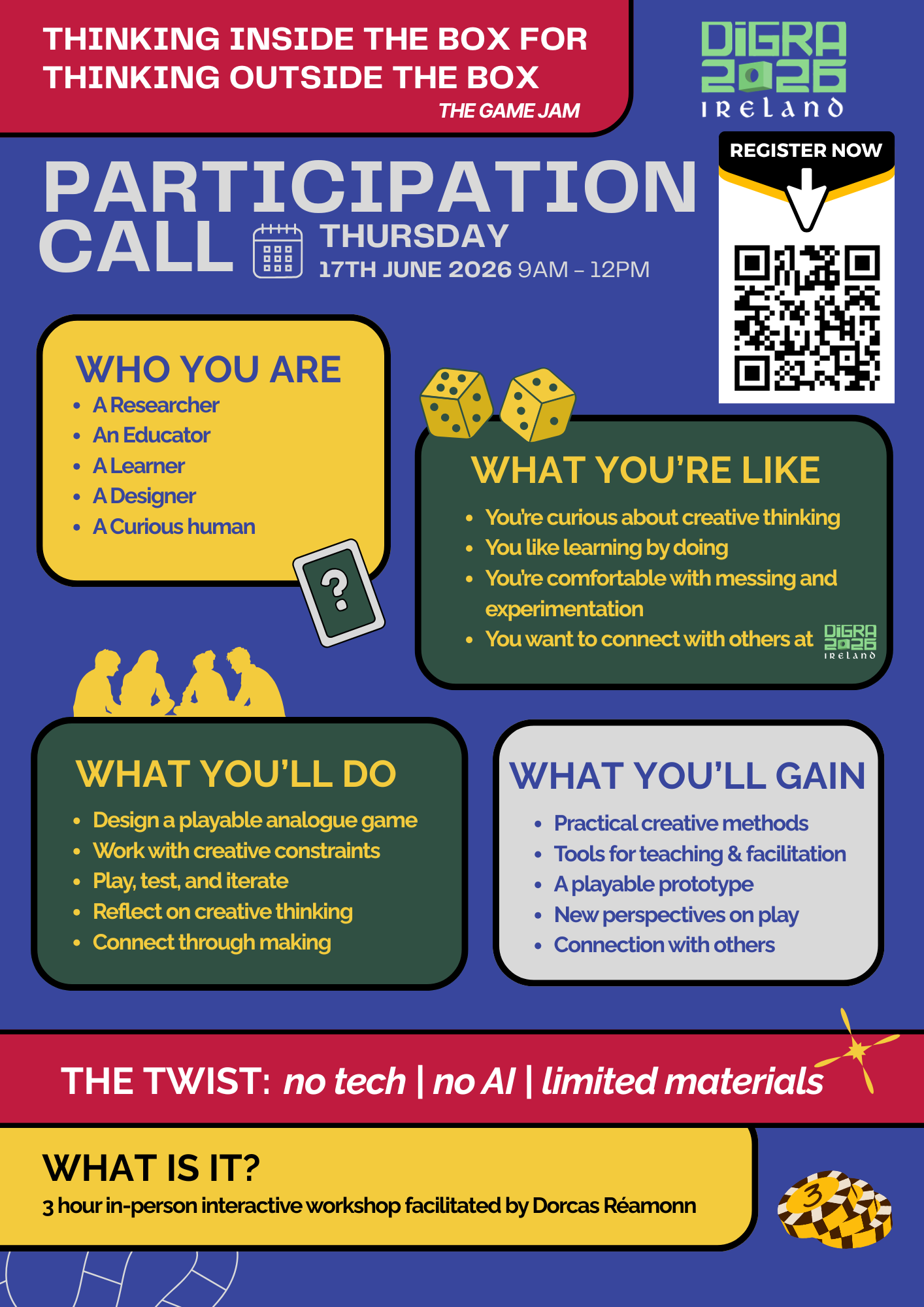
This workshop explores how analogue game design, supported by structured facilitation, can be used to create games that foster creative thinking. Through a collaborative, hands-on game jam, participants will co-design, prototype and play analogue games that use constraints, rules, and play to support creative processes
Participants will leave with playable prototypes, adaptable facilitation approaches, and renewed insight into how games can function as tools for creative inquiry, learning, and community-building.
Thinking inside the Box for Thinking outside the Box
Dorcas Reamonn
Location: Classhall D

C o n t a c t U s digraireland2026@gmail.com